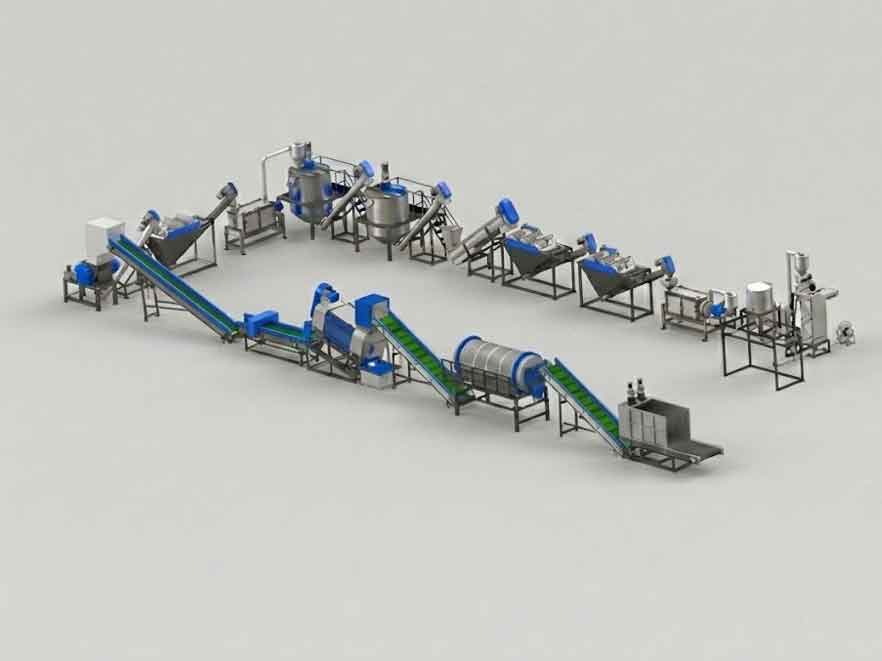
PET Bottle Recycling Solution (Bottle-to-Flake / Bottle-to-Bottle)
Complete turnkey solution for turning post-consumer PET bottles into high-purity rPET flakes. De-labeling, hot washing, and flake purification deliver food-grade output for packaging, fiber, and bottle-to-bottle applications.
- Food-grade rPET flakes for bottle-to-bottle or fiber
- High-label and bale-fed bottle handling
- Caustic hot wash for contamination removal
- Sink-float separation for purity
Typical response: within 12 hours · Engineering-driven proposal
Best For
Typical Process Flow
Bale breaking & de-labeling — Unbales and separates bottles from labels; hot-wash chemistry aids label removal.
Hot wash & sink-float — Caustic removes organics and glue; sink-float separates PET from PE/PP caps and labels.
Drying & optional pelletizing — Clean flakes dried to low moisture; optional extrusion + SSP for bottle-to-bottle IV and AA control.
Key Outputs & Quality Targets
Output form
Clean PET flakes (or rPET pellets with optional extrusion + SSP).
Contamination / moisture
Target <50 ppm contamination; moisture <500 ppm before extrusion.
Optional add-ons
Optical sorting, laser filter, SSP for IV/AA control, bottle-to-bottle readiness.
Standard Line Configuration
Engineering Notes
What label types can the line handle?
OPS, PVC, PE sleeves, and paper labels. Hot wash chemistry can be tuned for your label mix.
What hot wash chemistry is used?
Caustic soda (NaOH) with optional surfactants. Temperature and dwell time are set for your contamination level.
What contamination levels can be achieved?
Typically <50 ppm foreign material. Optical sorting and laser filter can improve further for bottle-to-bottle.
What capacity range is available?
500–5000 kg/h for flakes; pelletizing capacity depends on extrusion configuration.
Is the line bottle-to-bottle ready?
With optional SSP (solid-state polycondensation) and IV/AA control, output can meet food-contact standards.
Related Equipment
Request a Free Quote
Get a customized PET recycling solution proposal from our engineers.